
The hidden costs of a kitchen renovation in Toledo regularly add $5,000 to $20,000 on top of whatever a homeowner originally budgeted, and they almost always come as a complete surprise. Not because contractors are hiding them. Because these costs live behind walls, under floors, inside electrical panels, and inside permit offices, and they simply cannot be identified until the demolition phase begins.
Toledo’s housing stock makes this reality sharper than it is in newer markets. A large portion of homes across neighborhoods like Westgate, Beverly, South Toledo, the Old West End, and Point Place were built between the 1920s and 1970s. Decades of ownership, deferred maintenance, and previous renovations of varying quality mean that virtually every kitchen in an older Toledo home is sitting on top of at least one surprise that a contractor will uncover once the cabinets come down and the flooring comes up.
This guide covers every hidden cost category that repeatedly catches Toledo homeowners off guard, what each one realistically costs in the local market, and how to protect yourself financially before your project begins.
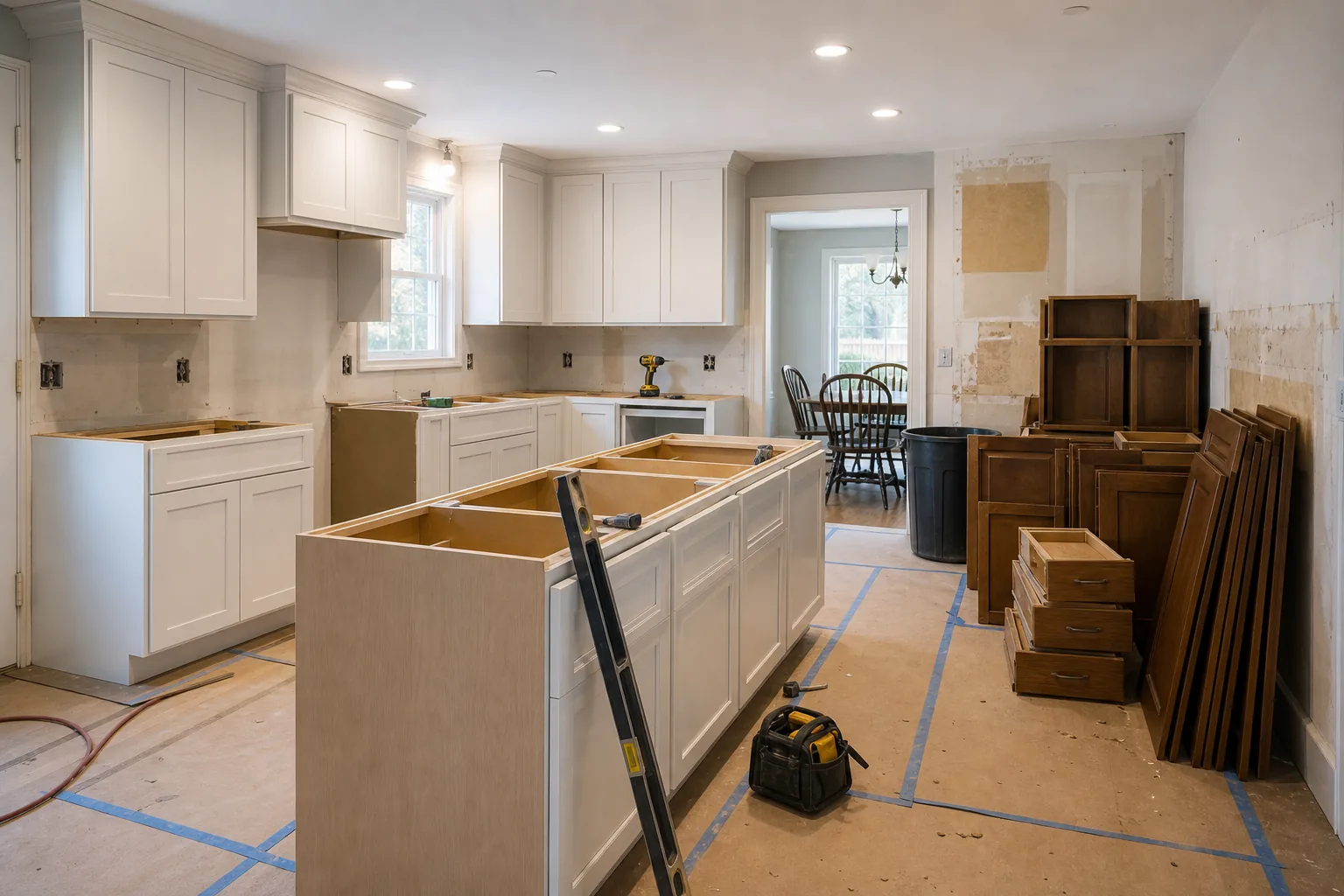
Why Toledo Homes Have Different Hidden Costs Than Everywhere Else
Most articles on hidden renovation costs give you a generic list that applies equally to a condo in Miami and a Victorian in Ottawa Hills. That is not useful if you are actually planning a kitchen remodel in Toledo. The specific risks here are shaped by the age of local homes, by Lucas County’s permitting requirements, by Northwest Ohio’s climate, and by the infrastructure decisions that contractors and city inspectors will flag during your specific project. Everything in this article is grounded in those Toledo-specific realities.
The Contingency Fund: Budget for This Before Anything Else
Before addressing any specific surprise, the most important thing to understand is that nearly 70 percent of homeowners experience budget overruns during renovation projects. The reason is not that contractors are bad at estimating. It is that visible surfaces tell you almost nothing about what is happening inside the walls and floors of a house.
Experienced Toledo contractors consistently advise setting aside a contingency fund of 10 to 15 percent of your total project budget before work begins. On a $35,000 mid-range renovation, that means having $3,500 to $5,250 in a separate account that you do not touch unless something unexpected gets uncovered. On a $55,000 project it means $5,500 to $8,250. This is not pessimism. It is the standard financial framework that licensed professionals use to protect their clients from project-stopping surprises.
10 Hidden Costs That Catch Toledo Homeowners Off Guard
Hidden Cost 1: Subfloor Damage
Subfloor problems are the single most common hidden cost in Toledo kitchen renovations, and they are almost uniquely tied to the region’s older housing stock. Here is how it happens. Decades of minor moisture exposure from dishwasher leaks, a slow supply line drip, poor caulking around the sink, or condensation near the exterior wall gradually soften the wooden subfloor beneath the existing kitchen flooring. The existing vinyl, tile, or laminate looks completely fine from above. Nobody knows anything is wrong until demolition begins and a contractor steps through.
Once the subfloor is exposed, the scope of damage varies. A minor soft spot around the sink area might cost $300 to $800 to repair by sistering damaged joists and replacing the affected plywood. Extensive moisture damage covering 30 to 50 percent of the kitchen subfloor can cost $2,000 to $6,000 to address properly, particularly in homes where the kitchen sits above an unheated crawl space, which is common in Toledo bungalows and two-story homes from the early postwar era.
What makes this cost truly hidden is that no one can tell you what they will find before the old flooring comes up. Even a pre-renovation inspection with moisture meters gives you a probability estimate, not a certainty. Budget for it before work starts and consider the money well spent if the subfloor turns out to be fine.
Hidden Cost 2: Electrical Panel Capacity and Wiring Upgrades
Modern kitchens are electrically demanding spaces. A standard kitchen renovation today typically involves a dishwasher, refrigerator, microwave, garbage disposal, range or cooktop, range hood, and multiple countertop outlets. Each of these draws power, and the cumulative load frequently exceeds what older Toledo homes were wired to handle.
Knob-and-Tube Wiring
Homes in Toledo’s oldest neighborhoods, the Old West End, parts of the South End, and East Toledo in particular, were built during an era when knob-and-tube wiring was standard. This type of wiring lacks a ground wire, does not support modern GFCI protection requirements, and cannot safely handle contemporary electrical loads. Most homeowner’s insurance policies will not cover a kitchen renovation until knob-and-tube wiring in the affected area is replaced. Remediation costs range from $2,000 to $12,000 depending on how much of the system needs to be addressed.
Panel Upgrades
Homes from the 1950s and 1960s frequently have 60-amp or 100-amp electrical panels that were adequate for the era but fall short of what a modern kitchen renovation requires. A new 200-amp panel typically costs $2,500 to $4,500 installed in Toledo, including the permit and inspection. This cost is non-negotiable. It cannot be worked around, and no licensed electrician will complete a kitchen renovation that demands more power than the panel can safely supply.
GFCI and AFCI Requirements
Ohio building code requires ground fault circuit interrupter outlets near all sinks and countertop surfaces, and arc fault circuit interrupter protection on all kitchen circuits. In a kitchen that has never been updated, meeting these requirements during a renovation adds $500 to $1,500 for an experienced licensed electrician. In a kitchen with older wiring that needs significant remediation, these costs are embedded within the larger electrical upgrade.
Hidden Cost 3: Plumbing Issues Behind the Walls
Plumbing surprises in Toledo kitchens fall into two categories. The first is existing damage that nobody knew about. The second is code-required upgrades that get triggered once a contractor opens the wall to relocate the sink or add a dishwasher connection.
Galvanized and Cast Iron Pipes
Homes built before the 1970s in Toledo commonly have galvanized steel supply pipes, which corrode from the inside over time and gradually restrict water flow. Cast iron drain lines, while more durable, can crack and shift in foundations over decades. Neither issue is visible from the kitchen surface, and neither becomes a mandatory repair until a renovation opens the walls and a plumbing inspector reviews the exposed work. Replacing a section of galvanized supply line in a kitchen adds $800 to $2,500 depending on accessibility and length. Repiping an entire kitchen section from the main supply costs $2,000 to $5,000.
Drain Line Rerouting
If your kitchen renovation involves relocating the sink, adding an island with a sink, or changing the dishwasher’s position, the drain lines must be rerouted to accommodate the new placement. This work requires cutting through the floor, accessing the drain stack, and sometimes modifying the slope of the drain line to meet the 1/4 inch per foot fall requirement. In Toledo homes with concrete slab foundations, this work is more complicated and costly than in homes with wood-frame floors above a basement. Drain rerouting typically adds $1,500 to $4,500 depending on the distance, access conditions, and whether any concrete cutting is required.
Hidden Cost 4: Asbestos and Lead Paint Abatement
This is the hidden cost Toledo homeowners in older neighborhoods most frequently underestimate, both in likelihood and expense.
Asbestos
Homes built before 1980 may contain asbestos in vinyl floor tiles, sheet flooring adhesive, pipe insulation, and drywall joint compound. Toledo’s housing stock puts a significant percentage of its kitchens squarely in the at-risk category. Asbestos is not hazardous if it is intact and undisturbed. The moment a renovation involves sanding, cutting, or demolishing materials that contain it, abatement becomes legally required. A licensed asbestos abatement contractor must test, remove, and dispose of the material. Testing alone costs $200 to $500. If asbestos is confirmed, abatement for a single kitchen typically costs $1,500 to $4,000 depending on the extent of affected materials and whether encapsulation or full removal is required. This work must be completed before any other trades can enter the space.
Lead Paint
Homes built before 1978 may have lead-based paint on walls, trim, and any previously painted surfaces inside the kitchen. Ohio follows EPA Renovation, Repair, and Painting program rules, which require certified contractors to use lead-safe work practices on any project that disturbs painted surfaces in pre-1978 homes. In practice this means protective sheeting, sealed work areas, HEPA vacuuming, and certified disposal of lead-containing debris. These practices add labor time and materials to the project. The cost premium for RRP compliance in a Toledo kitchen typically adds $500 to $2,000 to labor costs depending on the extent of painted surface disturbance involved.
Hidden Cost 5: Lucas County and City of Toledo Building Permits
Many Toledo homeowners budget for permits as a single line item, then discover that a full kitchen renovation requires multiple separate permits issued by different departments, each with its own fee and inspection schedule.
A kitchen renovation involving structural changes, new electrical circuits, and plumbing modifications can require a building permit, an electrical permit, a plumbing permit, and in some cases a mechanical permit if the range hood venting system requires new ductwork through the roof or exterior wall. Each permit carries its own fee. The City of Toledo Division of Inspection charges based on project valuation. A mid-range kitchen renovation with multiple trade permits typically generates $400 to $1,200 in permit fees, sometimes more.
The bigger financial risk with permits is not the fee itself. It is the code compliance work that permit inspections sometimes require. An inspector reviewing electrical work in an older home may require additional GFCI protection beyond what was originally scoped. A structural inspection following a wall removal may require a beam specification revision. These requirements are not discretionary. They are corrections required before the inspector will sign off on the project. Budget $500 to $2,000 for code compliance costs that emerge from the inspection process itself.
Working without permits creates far larger problems downstream. Unpermitted work in Toledo can result in stop-work orders, mandatory demolition of completed work, fines, and significant complications when the property is sold. No licensed contractor in Lucas County will complete electrical, plumbing, or structural work without pulling the required permits.
Hidden Cost 6: Structural Discoveries Behind Walls
If your kitchen renovation involves removing a wall to open up the floor plan, which is one of the most common requests in Toledo kitchen remodels, a structural engineer must be involved before demolition begins. Older Toledo homes were built with load-bearing walls in configurations that do not always match what appears logical from a modern design perspective. A wall that looks like a simple partition between the kitchen and dining room may be carrying roof load.
When a load-bearing wall comes down, it must be replaced by an engineered beam, typically a laminated veneer lumber or steel beam, that transfers the load to the foundation. The beam specification, installation labor, temporary support structure during removal, and the columns or posts needed to carry the beam to the foundation add $5,000 to $15,000 to a project depending on wall length and structural configuration. This cost is genuinely impossible to know with certainty until the engineer reviews the framing.
Pest damage is another structural discovery that surfaces during kitchen renovation in older Toledo homes. Carpenter ant activity and termite damage to rim joists, sill plates, and floor framing near exterior walls and crawl space access points is not uncommon in homes that are 60 to 80 years old. Repairs to structurally compromised framing members add $1,500 to $8,000 depending on the extent of the damage.
Hidden Cost 7: HVAC Duct Conflicts
Kitchen cabinet layouts do not always align with the existing duct work positions inside the walls and floor. When a cabinet run is being reconfigured or an island is being added, existing HVAC supply and return ducts frequently end up in conflict with the new layout. Moving a supply register requires sheet metal work, a new duct run, and in some cases rerouting a duct branch back to the main trunk line.
This is one of the most commonly overlooked costs in Toledo kitchen renovations because the conflict only becomes apparent once the demolition exposes the actual duct positions. Duct relocation for a kitchen renovation typically adds $500 to $3,000 depending on complexity. If the renovation is also upgrading the kitchen’s ventilation by adding a proper range hood that vents to the exterior, a new duct penetration through the wall or roof adds another $300 to $800 for a licensed HVAC technician to install properly.
Hidden Cost 8: Temporary Kitchen Setup and Living Arrangements
This is the cost Toledo homeowners almost universally fail to account for. A full kitchen renovation puts your kitchen completely out of service for four to eight weeks, sometimes longer in older homes where infrastructure work extends the timeline. During that period your household needs to eat.
The actual financial impact adds up faster than most families expect. Restaurant and takeout spending during a renovation can easily reach $1,500 to $3,500 over a six-week project for a family of four, even with deliberate budget management. Setting up a temporary kitchen in another room with a microwave, a coffee maker, a toaster oven, and a small dorm refrigerator helps reduce this cost but involves some equipment expense of its own.
If the project extends into your living space in ways that make the home genuinely difficult to occupy, short-term rental costs for even a few weeks add significantly. Toledo has a reasonable short-term rental market, but even modest temporary accommodations add $1,500 to $4,000 per month.
Hidden Cost 9: Delivery, Installation, and Haul-Away Fees
When Toledo homeowners get quotes for cabinets, appliances, and countertops, those quotes often reflect the cost of the product itself rather than the full cost of getting the product properly installed. Several add-on fees regularly appear on final invoices that were not clearly itemized in the original estimate.
Countertop templating and fabrication setup fees are sometimes charged separately from the countertop material and installation cost. Appliance delivery, haul-away of old appliances, and installation fees for built-in units like dishwashers and range hoods are frequently additional. Cabinet delivery fees for large orders can add $200 to $600 depending on the supplier and order size. Post-construction cleaning, which leaves the kitchen genuinely ready to use, costs $300 to $600 for a professional cleaning service and is almost never included in a contractor’s scope of work.
Ask every supplier and contractor to provide a complete list of all fees beyond the core quote before signing anything. These line items are not dishonest. They are standard practice. But they are invisible until you know to ask.
Hidden Cost 10: Change Orders After Work Begins
The most controllable hidden cost in a kitchen renovation is also the most common. Change orders, meaning requests to modify the scope of work after construction has started, are the primary reason kitchen renovations go over budget in ways that have nothing to do with structural surprises.
Deciding mid-project that you want a different tile, upgrading to a deeper sink than originally specified, adding outlets that were not in the original plan, switching from the originally specified countertop to a higher-grade material, or extending the backsplash height after seeing how it looks in progress all generate change orders. Each one adds labor time, material cost, and potentially a delay. In Toledo, mid-project changes routinely add $1,000 to $5,000 to a project depending on their nature and timing.
The solution is thorough upfront decision-making before demolition begins. Every material selection, every fixture specification, every detail about what goes where should be finalized and confirmed in writing before a contractor removes the first cabinet. Changes become exponentially more expensive once construction is underway.
How to Protect Yourself Financially Before Your Toledo Kitchen Renovation
The goal is not to eliminate surprises. In an older Toledo home, that is not realistic. The goal is to not be financially paralyzed by them.
Set your contingency fund first, not last. Before signing a contract, transfer 10 to 15 percent of your total budget into a separate account designated exclusively for project surprises. Treat it as already spent. If you do not need it, great. If you do, the project keeps moving.
Request a pre-renovation walkthrough assessment. A thorough contractor will provide a detailed review of likely risk areas in your specific kitchen before the estimate is finalized. In Toledo homes built before 1975, this should explicitly address subfloor condition, electrical panel capacity, visible plumbing material type, and any signs of prior moisture intrusion behind the sink area.
Ask for a fully itemized written estimate. Every line item including labor, materials, permit fees, subcontractor work, delivery fees, and disposal costs should appear separately. A single lump sum gives you no ability to track where money is going or to evaluate whether a particular line item is reasonable.
Hire licensed tradespeople for every trade category. In Ohio, electrical, plumbing, and HVAC work legally requires licensed contractors. Working with unlicensed tradespeople to save money is one of the most reliable ways to face permit compliance issues, insurance claim denials, and mandatory rework costs later.
Frequently Asked Questions
What is the most common hidden cost in a Toledo kitchen renovation?
Subfloor damage discovered after the existing flooring is removed is the most frequently encountered hidden cost in Toledo kitchen renovations, particularly in homes built before 1975. Electrical panel inadequacy is a close second.
How much should I budget for unexpected costs in a Toledo kitchen remodel?
Set aside 10 to 15 percent of your total project budget as a contingency fund before construction begins. On a $40,000 renovation that means having $4,000 to $6,000 available specifically for surprises that emerge during demolition or construction.
Do all Toledo kitchen renovations require permits?
Any kitchen renovation involving structural changes, new electrical circuits, or plumbing modifications requires permits through the City of Toledo or Lucas County. Cabinet replacements and countertop swaps that do not disturb electrical or plumbing systems may not require a permit, but any trade work involving licensed electricians or plumbers will require the appropriate trade permits.
How do I know if my Toledo home has asbestos before starting a renovation?
If your home was built before 1980, have a licensed Ohio asbestos inspector test floor tiles, adhesive, pipe insulation, and drywall compound in the kitchen before demolition begins. Testing costs $200 to $500 and is far less expensive than discovering the issue mid-project when work must stop until abatement is completed.
Can I avoid hidden costs by only doing a cosmetic kitchen refresh?
A purely cosmetic refresh that does not involve removing existing flooring, opening walls, or touching electrical and plumbing systems significantly reduces your exposure to hidden infrastructure costs. Cabinet repainting, hardware replacement, countertop overlays, and fixture swaps carry far less hidden cost risk than full gut renovations.
Our team works exclusively on kitchen remodels across Toledo, Ottawa Hills, Perrysburg, Maumee, Sylvania, Waterville, and throughout Lucas County. If you want an honest, room-specific sense of these costs before you commit to a budget, our 2026 Toledo cost guide is a good next stop.
Want to see how these costs fit into an overall project budget? See cost by room size.