
Kitchen Lighting Design in Toledo, Ohio
Layered lighting plans — task, ambient, and accent — that make your kitchen work at 6am prep and glow at 8pm dinner.
See Your Price Range
Real Toledo kitchen remodel costs by project size — instantly, no forms.
Free to read. No email required.
One Ceiling Fixture Is Not a Lighting Plan
Most Toledo kitchens we walk into are lit by a single ceiling fixture that casts the cook’s own shadow onto every cutting board in the room. The fix isn’t more brightness — it’s layers.
Task lighting puts light where work happens: under-cabinet strips washing the counters, pendants over the island, a fixture over the sink. Ambient lighting fills the room comfortably — recessed cans on a dimmer, sized and spaced to the ceiling height. Accent lighting adds the depth that makes kitchens photograph well: glass-cabinet interiors, toe-kick strips, a picture light on open shelving.
Layered properly, the same kitchen serves as a bright workspace, a family hub, and — dimmed — the best-looking room at the party. This matters extra in Northwest Ohio, where November through March asks your lighting to replace the sun for sixteen hours a day.
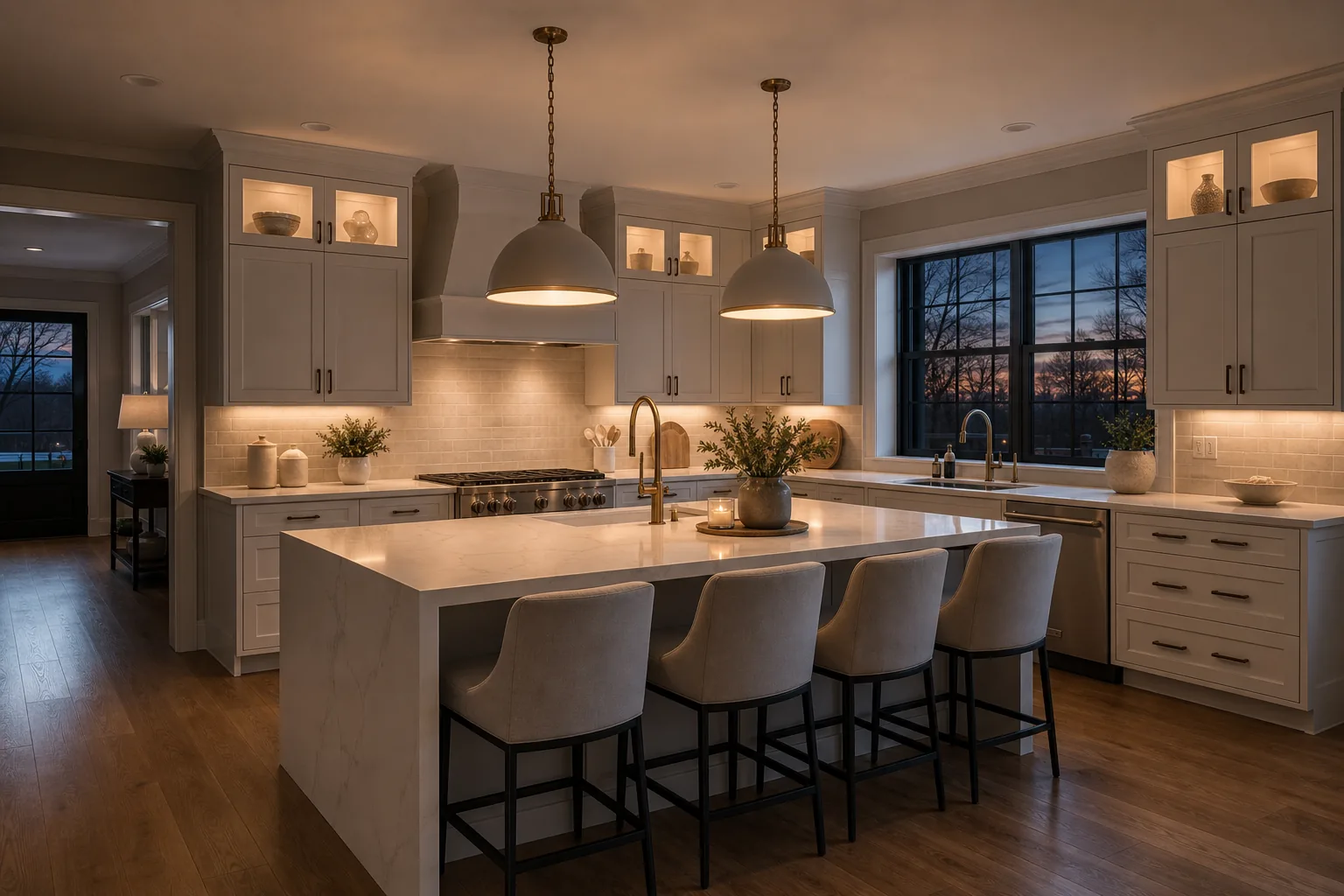
Every Layer, Explained
Pendant Lighting
Islands take pendants at 30–36 inches above the counter, spaced so light pools overlap. Scale matters: two large beats three small over most Toledo islands.
Under-Cabinet Lighting
LED strips mounted at the cabinet’s front edge (not the back — that just spotlights your backsplash grout). The single highest-impact upgrade per dollar in kitchen lighting.
Recessed Lighting
Four-inch LEDs spaced roughly half the ceiling height apart, kept 24–30 inches off the wall so upper cabinets don’t shadow the counters. Always on dimmers.
Task Lighting
Dedicated fixtures over sink and range beyond the hood light — the two stations where under-lit work actually causes accidents.
Accent Lighting
In-cabinet lighting for glass doors, toe-kick strips for evening navigation, LED channels on floating shelves. Cheap wiring during a remodel, expensive retrofits after.
Smart Controls
Scene presets — “cooking,” “dinner,” “midnight snack” — from a keypad or phone. Genuinely useful, not gadgetry, once you have layers worth controlling.
The Technical Details That Make or Break It
Color Temperature Discipline
Everything in one kitchen should match — we spec 2700K–3000K throughout for warmth that flatters wood tones and food alike. Mixed temperatures make even expensive kitchens look off.
High CRI Everywhere
Color Rendering Index above 90 means your quartz looks like the slab you picked and your food looks like food. Bargain LEDs at CRI 80 are where kitchens go to look gray.
Dimmers as Standard
Every layer on its own dimmer. The difference between a kitchen that does one thing and a kitchen that does everything is about $40 a switch during the remodel.
Circuit Planning
Lighting loads planned with the electrical rough-in — including the dedicated circuits Toledo code requires for appliances — so nothing flickers when the microwave runs.
Lighting FAQ
Can you add lighting without a full remodel?
Under-cabinet lighting and pendant swaps are very doable standalone. New recessed layouts depend on attic or ceiling access — we’ll assess in a free consultation.
Warm white or cool white?
Warm (2700K–3000K) for homes, consistently. Cool white belongs in workshops. The showroom “daylight” look reads clinical in a real kitchen.
How many recessed lights do I need?
Fewer than most electricians install. Spacing at half the ceiling height, focused over work zones, beats a ceiling full of cans that flattens the room. The plan matters more than the count.
A Sample Lighting Plan for a Real Toledo Kitchen
Abstract lighting advice gets clearer with a worked example. Take a 12-by-14 kitchen in a Sylvania-area ranch — eight-foot ceiling, window over the sink, island added during remodel. Here’s the actual plan we’d build.
Ambient layer: six 4-inch LED recessed fixtures, 3000K, CRI 92, arranged in two rows kept 30 inches off the cabinet faces so light lands on counters rather than on cabinet doors. Total ambient output around 4,800 lumens, on one dimmer. On a February evening this layer alone makes the room feel inhabited rather than fluorescent.
Task layer: LED strips under every upper cabinet, mounted at the front edge behind the light rail, spitting light down onto the work surface where knives operate. Sink gets a dedicated 3-inch recessed fixture centered on the basin — the window helps at noon and abandons you by dinner. All task lighting switches together near the main entry.
Feature layer: two pendants over the island — sized generously, hung 32 inches above the counter, on their own dimmer. Inside the two glass-door uppers, warm LED pucks. Toe-kick strips under the island base for the midnight-snack path. Three circuits, three dimmers, one keypad by the doorway with scenes labeled Cook, Dinner, and Late. Total fixture budget in a Toledo remodel: roughly $1,800–$2,600 installed — the highest satisfaction-per-dollar line on the whole quote.
Go Deeper on Lighting
Keep Exploring
Get a Free Estimate for Your Project
Real Toledo pricing by project size — honest guides, no forms, no pressure.