2026 Kitchen Design Trends Toledo Homeowners Are Actually Choosing
Design trends move fast on social media and slowly in real houses. What we’re actually installing in Toledo-area kitchens this year is a narrower, more practical list than what shows up on a trend roundup — shaped by what holds up in Northwest Ohio homes, what suppliers can deliver on a reasonable timeline, and what homeowners are willing to live with for the next 10 to 15 years.
This is a working list based on the choices we’re actually seeing homeowners make across Toledo, Sylvania, Perrysburg, and the surrounding suburbs — not a generic national trend list.
Cabinet & Color Trends
Two-Tone Cabinetry Has Overtaken All-White
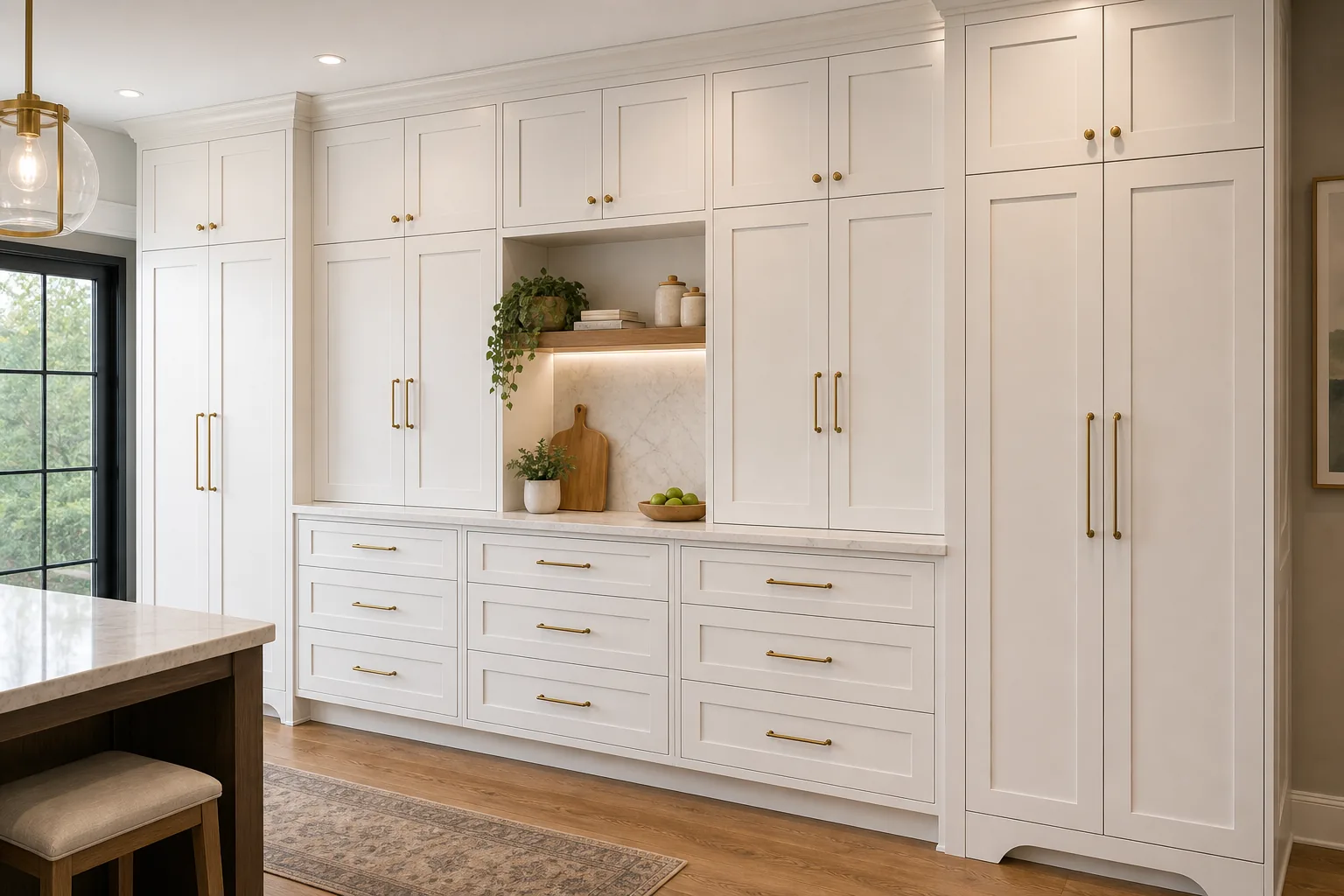
All-white kitchens dominated for most of the last decade, and they’re still common, but the majority of new projects we quote now use two-tone cabinetry: a darker or more saturated color on the island or lower cabinets, with white or a lighter neutral on the perimeter uppers. Navy, sage green, and warm charcoal are the three colors we’re asked for most. The appeal is practical as much as aesthetic — a painted island hides daily wear better than an all-white kitchen, and it gives the room a visual anchor without darkening the whole space.
Warm Wood Tones Are Replacing Cool Grays
The gray-on-gray kitchens that were everywhere from roughly 2015 to 2022 have fallen out of favor. What’s replacing them is warmer: honey and medium-toned wood cabinetry, wood-look flooring with visible grain, and brass or warm bronze hardware instead of matte black. This shift matters for Toledo homes specifically, because a lot of our older housing stock (Old West End, Westgate, parts of Sylvania) already has original wood trim and hardwood floors — warm-toned finishes read as intentional and cohesive with that architecture instead of fighting it.
Surface & Material Trends
Quartz Is Still Winning, But Veining Has Changed
Quartz remains the default countertop material in the large majority of our projects — see our full quartz vs. granite comparison for the full breakdown. What’s changed is the pattern homeowners are choosing. Bold, high-contrast veining (dramatic gray-and-white “waterfall marble” looks) is giving way to quieter, more subtle movement — softer veining in warmer white or cream tones that won’t feel dated in five years the way some of the boldest patterns from a few years ago already do.
Full-Height Backsplashes
Running tile or slab material from the counter all the way to the ceiling, rather than stopping at a standard 18-inch backsplash, is one of the most requested upgrades we’re seeing on full remodels. It’s not inexpensive — more material and more labor — but it reads as a significant design upgrade for a moderate cost increase, and it eliminates the visible seam between backsplash and wall paint that dates a kitchen quickly.
Layout & Fixture Trends
Furniture-Style Islands
Islands designed to look like a freestanding piece of furniture — turned or tapered legs, a contrasting wood or painted finish from the surrounding cabinetry, sometimes open shelving instead of enclosed cabinet doors — are replacing the uniform “big cabinet box” island that was standard for years. This pairs naturally with the two-tone cabinetry trend and works especially well in the older, more architecturally detailed homes common in Ottawa Hills and the Old West End.
Statement Lighting Over Practical Lighting
Pendant lighting has shifted from purely functional (small, matching, symmetrical) to a genuine design feature — oversized glass or woven pendants, mixed metal finishes, and asymmetrical groupings. We’re pairing this with more layered lighting overall: dedicated task lighting under cabinets, ambient recessed lighting, and a statement fixture, rather than relying on one central ceiling fixture the way most original Toledo kitchen wiring was designed for.
Integrated and Panel-Ready Appliances
On higher-end projects, panel-ready refrigerators and dishwashers — where a cabinet-matching panel covers the appliance face — are becoming a common request, especially in kitchens using the furniture-style island approach where a stainless steel appliance would visually interrupt the cabinetry. This is a meaningful cost increase over standard stainless appliances and isn’t the right fit for every budget, but it’s the single biggest visual difference between a “nice kitchen” and a kitchen that reads as fully custom.
What We’re Not Seeing Much of Anymore
Open shelving as a full replacement for upper cabinets has cooled off significantly — homeowners tried it, found it required constant tidying, and most of our current projects use it as an accent on one short run rather than the whole kitchen. Subway tile in the standard 3×6 white glossy format is also less frequently requested; when tile backsplashes are chosen, we’re seeing more zellige-style textured tile or larger-format tile instead.
Frequently Asked Questions
Do design trends matter if I’m planning to sell my home in a few years?
For resale, the safest choices are ones with staying power rather than the newest trend: quartz counters, warm-neutral cabinetry, and good lighting consistently perform well with buyers. Highly saturated cabinet colors or unusual material choices can help a kitchen stand out in photos but carry more risk if a future buyer’s taste differs from yours.
Is two-tone cabinetry more expensive than a single color?
Usually only modestly more, since it’s largely a paint/finish decision rather than a structural one. The bigger cost driver is whether you’re keeping your existing cabinet boxes and just changing finishes versus replacing cabinetry entirely.
How do I know which trends will actually work in my home’s architecture?
That depends heavily on your home’s age and existing style — a trend that suits a newer Perrysburg build might look out of place in a century-old Old West End colonial. See our Toledo cost guide for how design choices affect your budget.
Want to see how these trends affect project cost? Check our 2026 Toledo cost guide.